
Search for the satellite data

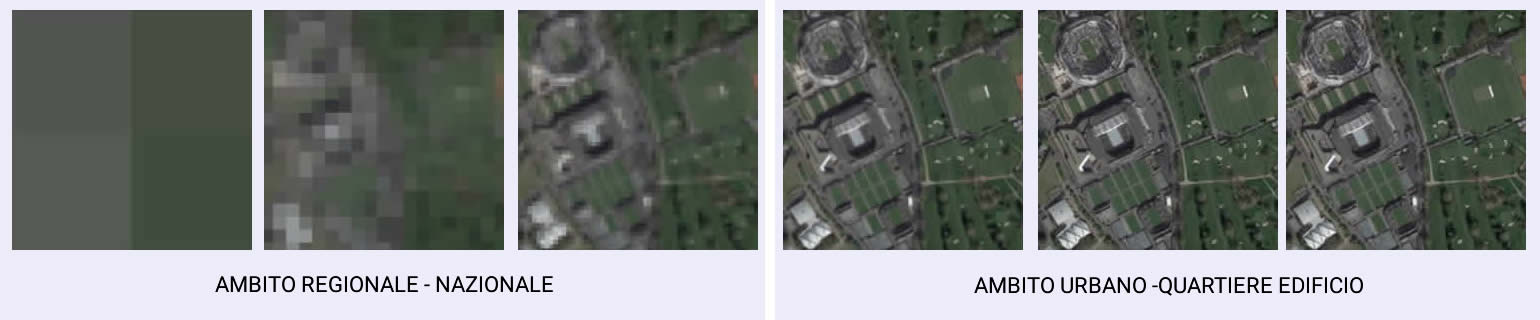
Select the area of your interest to identify the types of monitoring and satellites available
Value Added Services
DISTRIBUTION OF SATELLITE IMAGES
GEOREFERENTIATION
Two dimensional image correction process capable of associating known reference system real coordinates to an object within the image.
ORTHORECTIFICATION
Three dimensional image correction process (much more accurate than georeferencing) allowing the remote sensing image correction, in particular limiting the deformations occurred in the shot phase and those connected with the instrumentation used
RADIOMETRIC CORRECTIONS
Effects corrections due to the sensor sensitivity and the lighting different conditions.
ATMOSPHERIC CORRECTION
Radiance values distortions are the consequence of the atmosphere different layers crossing.
Atmospheric correction helps removing such disturbances.
Atmospheric correction is particularly important when multitemporal data must be compared and analyzed.
PATCHWORK AND BALANCING
Our software allow the generation of multiple images homogeneous patchworks in a short time: working on the colour balance, the results are excellent even starting from radiometrically different images.
AGRICOLTURAL INDEXES MAPS
it is possible to define quantitative dealings with vegetation spectral behaviors analysis in order to discriminate vegetation from other types of land use through the use of algorithms based on the typical spectral bands of absorption and reflection ratio.
THEMATIC AND DERIVATIVE MAPS
It is possible to extract value-added information of derived maps and specific themes forms, through remote sensing data process classification and photointerpretation Eg: land use maps, vegetation maps, slope maps, temperature maps
CHANGE DETECTION
Change Detection is the satellite remotely sensed image processing technique which purpose is to identify all the transformations occurring in a given territory over the time.
ORTOPHOTOCHARTS
An orthophotochart is essentially formed by a satellite ortho-image framed in a cartouche. A kilometric grid, a geographical grid and a cartouche with a series of added information are of main importance in order to facilitate its use and to frame the ortho-image in the chosen reference system
CARTOGRAPHY CREATION AND UPDATING
You can update the vectorial pattern of geographical database throuh a 2D and 3D cartographic return.
E.g .: CTRN, topographic DBs …
3-DIMENSIONAL SPACE ORIENTATION OF IMAGES ACQUIRED IN STEREOSCOPY
The stereoscopic vision allows to perceive three-dimensionality.
The images oriented in the three-dimensional space allow the acquisition of the stereoscopic vision and the images preparation for the 3D data extraction, both elevation models and photo-returned extracted objects.
DEM (DSM)
A Digital Elevation Model (also known as DEM, from the English Digital Elevation Model) is the representation of the territory or other surface distribution share in a digital format.
The digital elevation model is generally produced in a raster format, associating to each pixel the absolute quota related feature (NTT DATA ALOS DEM / DTM 5m).
DTM
For the most part of practical applications, the interest surface to model is the terrestrial soil surface. In this case we speak more precisely of Digital Terrain Model or briefly DTM, from the English Digital Terrain Model. A DTM is therefore a particular type of DEM (NTT DATA ALOS DEM / DTM 5 m).
The Planet high resolution multispectral satellite data and / or other satellites (Geoeye, Ikonos, Worldview, Spot …) images usage and the specific GIS and Remote Sensing know-how, together with the scientific coworkers support and (if necessary) the ground and / or other data sources surveys, allow to Iptsat added value high quality solutions and service proposals and new projects specifically designed on customer needs.
SATELLITE IMAGES CORRECTION AND PREPARATION SERVICES
Iptsat provides geometrical and radiometric correction services on any image acquired with optical sensors, with the following processing:
TOA (Top of Atmosphere) radiometric calibration: Reflectance value calculation at the top of the atmosphere (The various solar lighting conditions are standardized to different acquisition times).
Ground Atmospheric Correction: Calculation of the Ground Reflectance value (removing the atmosphere effects on the image).
Orthorectification: data can be orthorectified in different ways with or without GCP (Groundcontrol point) depending on the accuracy required, with the following methods:
- Orbital model using GCP
- Rational functions using RPC (Rational Polinomial Coefficient) with or without GCP
- Rational functions using GCP Stereoscopy orientation:
Orientation of two or more images acquired in stereoscopy for 3d information extraction applications (dem extraction, 3d photo-restitution).
CHANGE DETECTION AND HISTORICAL ANALYSIS
Change Detection is the processing technique of high-resolution satellite remotely sensed images acquired in different moments, for the identification and / or discrimination of the environmental and urban variations over the time.
In the updating territory analysis procedure, high-resolution satellite data are georeferenced and orthorectified according to the same aerial photos reference system previously used. The Change Detection is a useful step to keep track of variations not detectable otherwise within the official records or by sample surveys.
The satellite images used offer real and updated information thanks to the geometric high degree detail. These products allow urban and extra urban territory supervision, at regular ranges, hence following the territory development over the time.
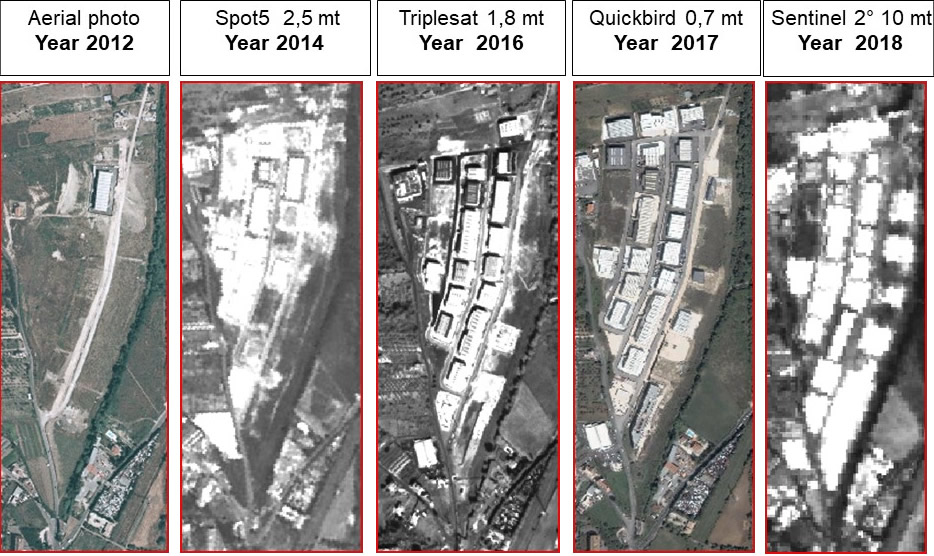
The Territory Analysis Technique allows to take a census of the timeframe changes by comparing multitemporal data.
DEM – STEREOSCOPY
A digital elevation model (also known as DEM, from the English Digital Elevation Model) is the representation of the territory, or other surface, shares distribution in a digital format. DEM can be produced with different techniques. Generally, the finest models are realized through remote sensing techniques involving radar or satellite stereocouples image processing.
Digital terrain models (DEM) usage is fundamental in many applications such as map generation, environmental monitoring, geospatial analysis, telecommunication engineering and more. Iptsat generates Dems from satellite images acquired by stereoscopy.
Iptsat methods include: the use of an orbital model, the attribution of points of control (Gcp) and homologous points (TP), the subsequent orientation of images, the generation of epipolar images (optional), the Dem extraction, correction and validation.
Through the partnership with NNT DATA and RESTEC, Iptsat distributes 3D worldwide data AW3DTM covering the whole world showing the ground undulations with highest resolution available on the market (5 METERS) using ALOS, the Japanese spatial agency, satellite PRISM data.
In-depth link: Asita 2014
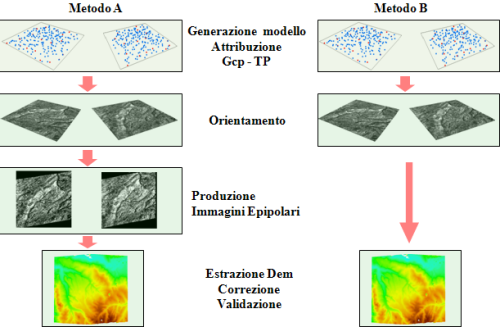
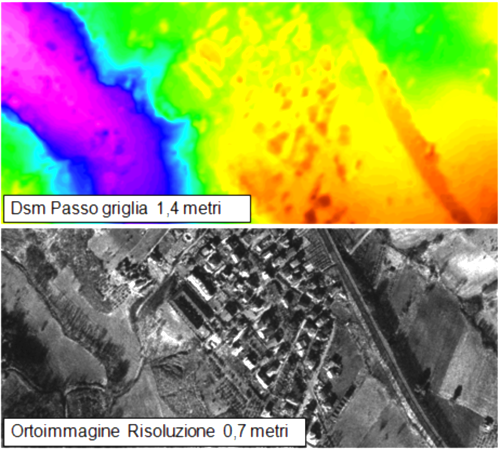
Example of DSM extracted form High resolution data.
CTRN AND DBT
The “Regional Numerical Technical Map” (CTRN) constitutes the basis reference for the municipal urban planning tools drafting, the Provincial Coordination, the Area and all the regional planning and programming different branches plans.
Satellite images and their processing are of fundamental support for the CTRN realization or update. Iptsat developped a way to reprocess and redefine the CTRN information as topographic geodatabases. The Lazio DTP (Topographical Database) implemented Domains and Template outline is already available on the Esri platform.
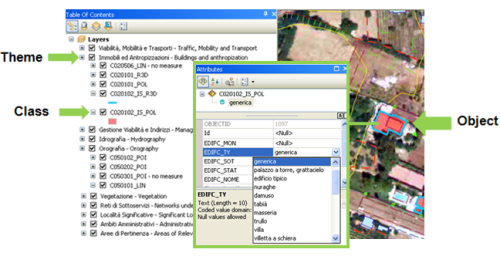
Geodatabase Eample “DBT Regione Lazio” on ArcMap Template.
ORTHOPHOTOCHARTS
The orthophotocharts can be considered as basic cartographic data, common use classic cartography supplementary or replacement (ctr, IGM cartography etc). Their use fits into a context in which there is a lack and/or total absence of updated cartographic data. The first situation occurs when you want to obtain an updated cartographic product, in a short time and at a reduced costs, having the same cartographic information requirements and the same level positional accuracy of traditional cartography.
The second situation frequently occurs in developing countries where a cartographic datum of reference is lacking; as a matter of facts, in the African countries, Albania or in other contexts orthophotocharts replace traditional cartography.
The main advantages of using Orthophotocharts are: lower production costs compared to traditional cartography, specific territory direct perception
and a drastic reduction in the cartography updating times especially in case of satellite data utilization. An orthophotochart is essentially formed by a satellite ortho-image framed in a cartouche.
To facilitate the ortho-image use and frame in the chosen reference system, a kilometric grid, a geographical grid and a cartouche with a series of further information are fundamental.
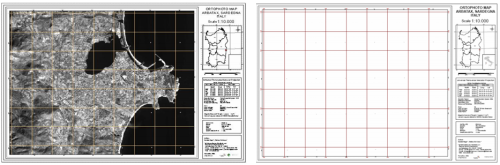
Example of the “DBT Lazio Region” Geodatabase on ArcMap Template.
VEGETATION INDEX MAPS
Thanks to multispectral and multitemporal remote sensing data processing, Iptsat is able to create vegetation index maps, essential for the state and change of agricultural, forest and vegetation resources classification and supervision:
NDVI and NDVI Red Edge Index Maps: Show the plant strenght differences Index maps fPAR and LAI: calculate the photosynthesis surface, the evapotranspiration and the net annual primary production estimation TCARI and MCARI index maps (Chlorophyll maps): show some plants nitrogen nutritional status OSAVI index maps: this index, thanks to the combination with the soil line, improve the reflectance contributions of the surrounding environment and the change sensitivity in the leaf chlorophyll content
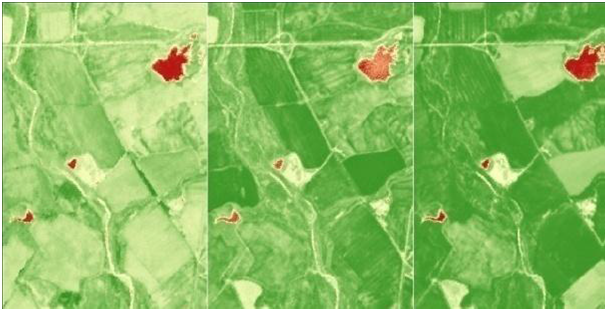
Example of multitemporal NDVI index map (Val d’Orcia) processed by RapidEye satellite data
High and Very High Resolution Data

Over the last few years, the possibility to employ scenes obtained through very high spatial resolution satellites has opened up further feasible applications scenarios on a very small scale, typical of local administrations and institutions. The created databases will represent a valid contribution to territorial governance activities, in particular by supporting topography activities, numerical cartography and photogrammetry, three-dimensional modeling, teritorial information systems Territorial and, above all, the Information Systems supporting decisions.
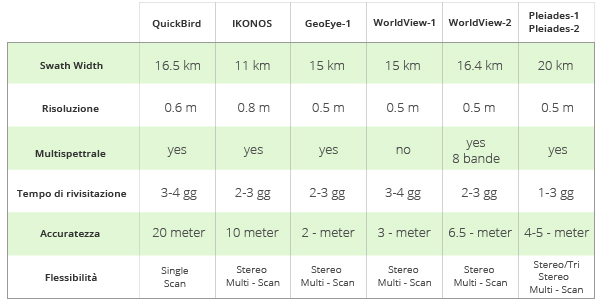
ULTRA HIGH MAIN RESOLUTION SATELLITES:
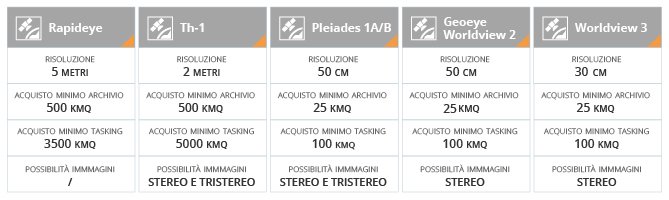
GeoEye-1
is a high resolution commercial remote sensing satellite for ground observation launched in orbit in September 2008. GeoEye-1 is equipped with a panchromatic resolution of 41 centimeters (16 inches) and a multispectral of 1.65 meters. It travels in an heliosynchronous orbit at 684km of height (425 miles) and 98 degrees inclination, with the equator crossing time of 10:30. The GeoEye-1 can store images up to 60 degrees outside the nadir.
IKONOS
is an artificial high spatial resolution commercial satellite: it was the first satellite capable of recording images with a resolution between 1 and 4 meters. It can offer both panchromatic than multispectral images.
IKONOS is able to get a ground resolution of 0.82 meters in panoramic mode (black and white) and 3.2 meters in the color or multispectral mode. These images can be fused together to create very high resolution color images.
WorldView-1
it is one of the most modern commercial satellites currently in orbit, equipped with high tech instruments for accurate geolocation and supplied by a panchromatic sensor providing images at a resolution of 50 cm. Launched in 2007, the sensor also acquires in stereo mode
with a high degree of accuracy; the stereo pairs thus generated guarantees
the extraction of Ground Digital Models (DEM).
WorldView-2
launched in October 2009, it is the first commercial ultra-high resolution satellite with 8 multispectral bands. Operating at an altitude of 770 kilometers, WorldView-2 offers a geometrical resolution of 46 cm in the panchromatic band and 1.85 meters in the multispectral one. WorldView-2 has an average revisiting time of 1.1 days and is able to collect up to 785,000 square kilometers images per day.
QuickBird
is an ultra-high resolution satellite, in orbit since 2001, it was designed to capture efficiently and with high accuracy large areas and is capable to acquire up to 75 million sq km of surface per year, provided with avery high resolution world catalogue data, updated with unprecedented frequency. QuickBird satellite data are suitable for all large areas mapping needs and can be used in many application fields such as territorial monitoring, prevention and natural risks management and change detection analysis.
Pleiades
are the first French dual observation satellites capable of meeting the needs of both European commercial and military users, with a wide range of applications, including mapping, urban development, hydrology, geophysics, volcanology, etc. This constellation is able to provide orthorectified color images up to 50 cm resolution, with a daily review time of any point on Earth. Furthermore the Pléiadi are able to capture high-resolution stereo images in one step. The image accuracy is about 3 meters, with a possible improvement – up to the exceptional value of 1 meter – with the use of GCP. Since the satellite was designed primarily for the emergencies management, the images request can take place up to six hours before acquisition. The satellite Pleiades 1A was launched in December 2011; Pleiades 1B in December 2012.
SPOT
The acronym SPOT refers to the French satellite series designed for the terrestrial resources study, the first of which was put into orbit on February 22, 1986. The SPOT images are able to satisfy geographical information needs in many fields: cartography, defense, agriculture, cadastral package identification, urban planning, telecommunications, environment. The images acquired by the sensors mounted on SPOT satellites are very useful as a source of information in order to study, monitor, predict natural phenomena and to direct programming activities, by supporting the decision making. The high resolution (up to 2.5 meters) makes the shapes and the measurement identifications of objects on the ground possible, allowing a medium-scale cartography creation (1: 50,000 /1: 100,000). With SPOT 2, 4, 5, and the new 6 and 7, (resolution 1.5 mt,) the SPOT mission has collected an archive of more than 30 million scenes since 1986.
Jilin Constellation
Jilin 1A is a Chinese satellite capable of acquiring images at 0.70m in the panchromatic resolution and at 2.88 meters in the multispectral one, with a swath lenght of about 11.6 km. The great advantage of this satellite is represented by the possibility of acquiring images in STEREO – TRIPLET mode, producing a DEM starting from 1.5 meters of absolute resolution. Another great advantage of this satellite is the extremely competitive cost
GF-2 satellite
The GF-2 is a Chinese satellite capable of acquiring images at 0.80 cm in the panchromatic resolution and at 8 meters in the multispectra,l with a swath lenght of about 70 km. The GF-2 can offer very high resolution images at the lowest cost on the market.
TripleSat
The triplesat constellation features 3 ultra high resolution satellites, with a spatial resolution of 0.8 cm and a swath per image of 23.4 km. It is a5 bands satellite, one pancormatic and 4 multispectral RGB + NIR.
Neo
The new Pleiades Neo satellites can acquire large territory portions at 30 cm of spatial resolution.
Planet
Planet constellation of over 200 different resolutions multispectral satellites, from 50 cm to 5 meters
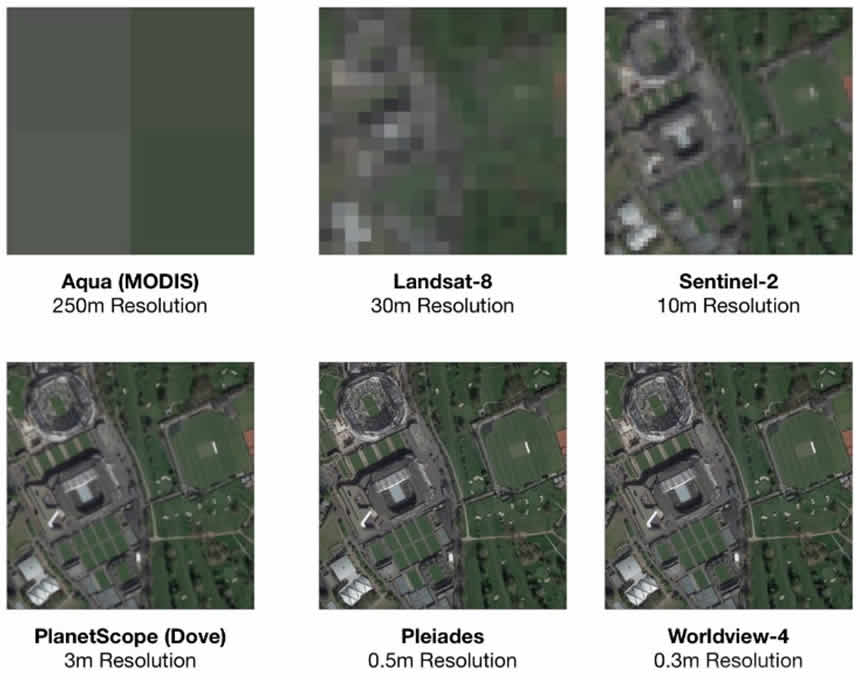
examples of different resolution types available today”
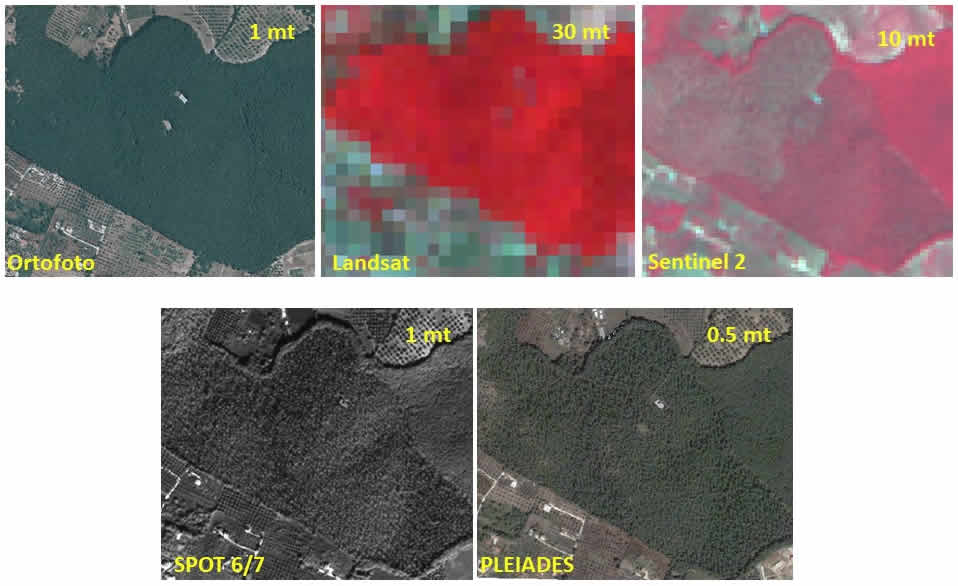
1 hectare at different resolutions
Copernicus Constellation
The European Copernicus satellite program, formed by a constellation of 6 satellites, called “Sentinels”, represents the cornerstone of the European Union’s efforts to monitor the Earth and its ecosystems through advanced satellite remote sensing systems.
The Copernicus program provides a huge amount of totally free information about our planet available to citizens, public authorities, scientists and business.
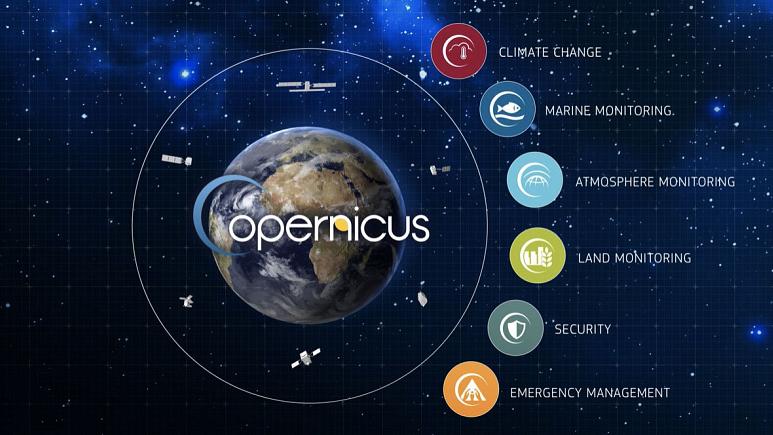
In 2014, with the launch of the first satellite, Sentinel-1A, the Union ushered the putting into orbit of a over a dozen satellites constellation in the upcoming ten years.
Copernicus allows to better understand how Earth is such an integrated system. European citizens, politicians and administrators, researchers, commercial and private users can benefit from the information provided by Copernicus services, in many ways, as well as the global scientific community.
Here are some examples of Copernicus added value in our daily life:
AGRICULTURE Periodical evaluation of cultivated areas; monitoring of crops development on a regional and global scale; food safety assessment; crop estimation; support for sustainable agricultural practices (e.g. estimating water needs)
CIVIL PROTECTION AND HUMANITARIAN AID Through the European Emergency Response Coordination Center (ERCC12): forecast and response organization to disasters and humanitarian crisis, accurate geographic information for the population rescue, logistics, fresh water supplying infrastructure, demographics, health and environmental facilities to areas affected by natural or man-made disasters
CLIMATE CHANGE Strong scientific evidence for the geophysical variables characterizing climate change; climate indicators (e.g. temperature increasing, sea level rising, ice melting, oceans warming ; climate index (based, for example, on temperature measurement, rainfall level, drought events);
COOPERATION AND DEVELOPMENT Applications to supervise agriculture and food assurance, deforestation, desertification and biodiversity in developing countries, in collaboration with partner countries and international organizations (such as the African Union, and the United Nations institutions);
ENERGY Valuable support to select and manage renewable energy production sites through information supply with specific characteristics, including water reserves presence, precipitation and snow accumulation levels during the winter; critical infrastructure control, such as nuclear power plants, or essential infrastructure protection such as power plants or gas / oil pipelines; energy efficiency evaluation in industrial plants and buildings
ENVIRONMENT Atmospheric composition, snow, ice and biodiversity monitoring; evaluation of water cycle parameters, such as soil moisture or water bodies analysis; forests and coastal areas monitoring; soil periodic supervision and waterproof surfaces evaluation; forestal heritage damage assessment and desertification monitoring; European oceans and seas, marine environment and coastal supervision, marine waters quality; observations such as the ocean color and the sea level;
INSURANCE Applications to support geological risk modeling, danger and damage assessment, claims management;
HEALTH Air quality check in Europe and global atmospheric composition; possible outbreaks of epidemics or disease mapping; public health emergency planning
BLUE ECONOMY Marine environment supervision in order to improve its knowledge and to encourage the maritime economy sustainable development in various areas including offshore hydrocarbon activities or coastal and marine tourism;
TOURISM Coastal areas supervision; supply of critical issues indicators and evaluation and planning index of seasonal tourism activities, such as the snow surface, the bathing water quality at European level; the natural and cultural heritage protection contribution;
AIR, LAND, MARITIME TRANSPORT Shipping routes or possible oil spills monitoring, maritime traffic control for safety reasons;aviation safety and air traffic support in exceptional circumstances; geological risk analysis and environmental risk assessment for land transport in critical areas
SECURITY European Union external actions support, including peacekeeping operations, European territory and sea borders supervision and surveillance, maritime general surveillance to support different communities;
URBAN AND REGIONAL PLANNING Land use and land use changements check on a regional or urban level ; detailed high resolution mapping of the major European cities, in support of urban planning ensuring balanced and sustainable development.
The various Sentinel missions will pursue the following targets:
- Sentinel-1 will provide radar data to support land area monitoring services. The first Sentinel-1a satellite was launched on 3 April 2014 with a Soyuz rocket from French Guyana.
- Sentinel-2 will provide high resolution optical images for terrestrial services (eg vegetation, soil, inland waters and coastal areas monitoring). Sentinel-2 was launched on 25 June 2015
- Sentinel-3 will provide services for global land and ocean areas monitoring. It has been launched on 16-2-2016.
- Sentinel-4 will provide atmospheric composition data.
- Sentinel-5 will support Sentinel-4 in providing atmospheric composition data.
- Sentinel-6 will contribute to precision elevation detection missions.
Reference link: www.copernicus.eu
